




Language:
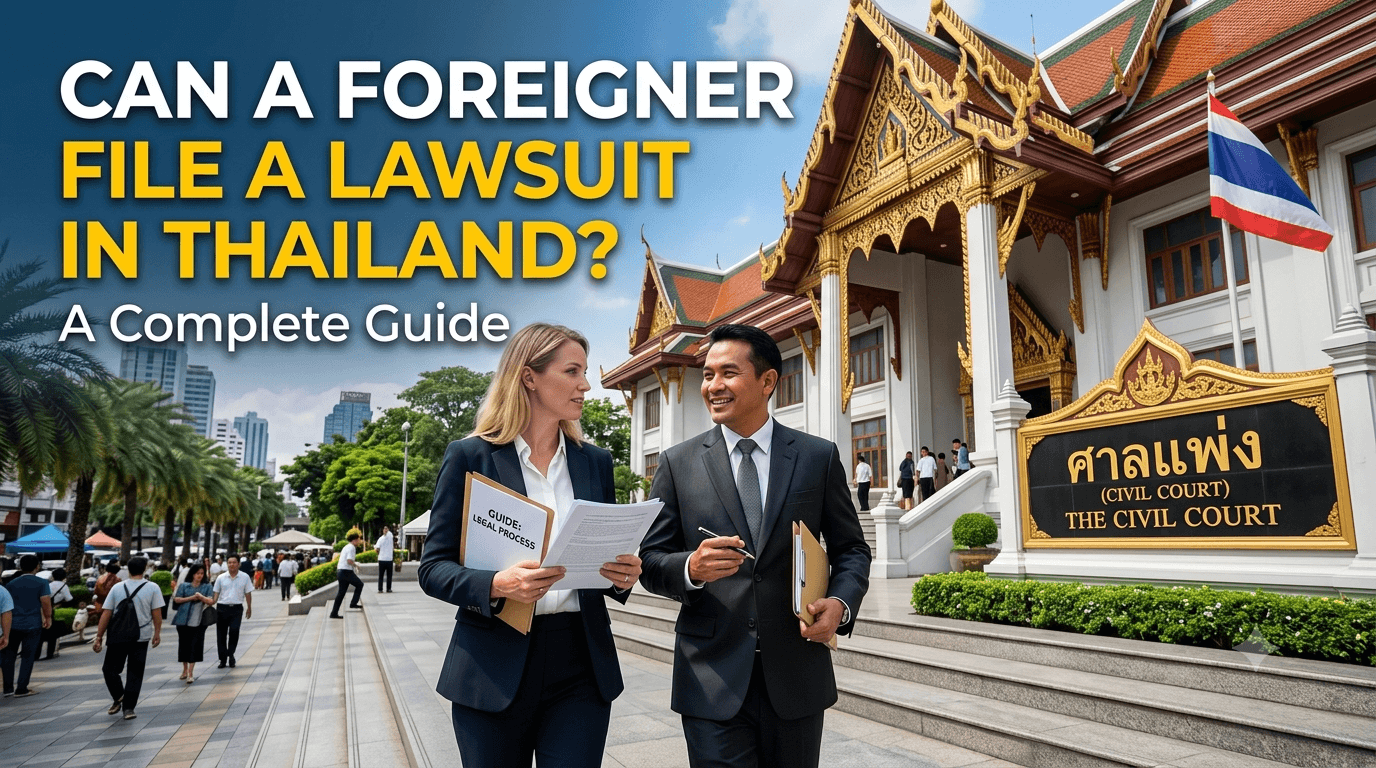
Can a Foreigner File a Lawsuit in Thailand? A Complete Guide
Can a foreigner file a lawsuit in Thailand? Yes, in many circumstances, a foreign individual or foreign company can bring a legal claim before a Thai court. However, the right court, legal procedure, evidence, jurisdiction, and supporting documents will depend on the facts of the case.
Foreigners may become involved in Thai legal proceedings as plaintiffs, defendants, witnesses, or other parties. Thailand’s government also specifically recognizes foreigners who are involved in legal proceedings in Thailand, including as plaintiffs and defendants.
If you are a foreigner involved in a dispute in Thailand, understanding the Thai litigation process before taking legal action is important. This guide explains how foreign individuals and companies can pursue a lawsuit in Thailand, what types of disputes may be brought before Thai courts, what documents may be required, and when you should consult a Thai litigation lawyer.
Can a Foreigner File a Lawsuit in Thailand?
Yes. A foreigner can generally file a lawsuit in Thailand when the circumstances of the dispute give the Thai courts jurisdiction over the case and the legal requirements for bringing the claim are satisfied.
A foreign plaintiff does not automatically have to be a Thai citizen to bring a civil claim in Thailand. The important questions are usually:
- What is the legal basis of the claim?
- Where did the dispute occur?
- Where does the defendant reside or operate?
- Is the dispute connected to Thailand?
- Which Thai court has jurisdiction?
- What evidence supports the claim?
- Are there contractual or legal requirements that must be satisfied before filing?
For civil cases, the Court of Justice explains that a plaintiff generally files a case with the court in the jurisdiction where the cause of action arose or where the defendant has a domicile. For disputes involving immovable property, the location of the property can also be relevant.
Therefore, being a foreigner does not by itself prevent you from bringing a lawsuit in Thailand.
What Types of Cases Can a Foreigner File in Thailand?
The type of legal dispute is one of the most important factors in determining whether a claim can be brought before a Thai court.
Foreign individuals and companies may encounter several types of disputes in Thailand.
1. Contract Disputes
Contract disputes are among the most common reasons a foreigner may need to take legal action in Thailand.
Examples include:
- Breach of a business contract
- Unpaid invoices
- Failure to deliver goods or services
- Disputes over construction contracts
- Lease agreements
- Employment agreements
- Partnership agreements
- Service agreements
- Commercial transactions
If a contract is governed by Thai law or the dispute has a sufficient connection with Thailand, Thai legal advice should be obtained before deciding how to proceed.
2. Debt Recovery Claims
A foreign individual or foreign company may need to recover money owed by a person or business in Thailand.
Examples include:
- Unpaid loans
- Outstanding invoices
- Unpaid business debts
- Failure to repay deposits
- Commercial payment disputes
- Unpaid contractual obligations
Debt recovery can involve negotiation, formal demand letters, court proceedings, and enforcement of a judgment.
Before filing a lawsuit, it is important to determine whether the debtor has assets in Thailand and whether pursuing litigation is commercially worthwhile.
3. Business and Commercial Disputes
Foreign investors and companies operating in Thailand may become involved in disputes involving:
- Shareholders
- Business partners
- Joint ventures
- Suppliers
- Customers
- Distributors
- Contractors
- Company directors
- Commercial agreements
These cases can become complicated because corporate documents, contracts, financial records, and evidence may be required.
Early legal advice can help identify the strongest legal strategy before a dispute escalates.
For businesses looking for preventive legal assistance, our Legal Advisory Services in Bangkok provide support with contracts, corporate matters, legal risk assessment, and business-related legal issues.

Can a Foreigner Sue a Thai Person or Thai Company?
Yes, depending on the circumstances and applicable law.
A foreigner may potentially bring a claim against a Thai individual, Thai company, or other entity when there is a valid legal basis for the claim and the Thai courts have jurisdiction.
For example, a foreign company may have a contractual dispute with a Thai supplier, while a foreign individual may have a claim involving a Thai business or another person in Thailand.
However, the fact that the defendant is Thai does not automatically mean that every dispute must be filed in Thailand. Jurisdiction must be assessed based on the specific facts and applicable law.
Can a Foreign Company File a Lawsuit in Thailand?
A foreign company may be able to bring legal proceedings before a Thai court.
This is particularly relevant when an overseas company has:
- A contract with a Thai company
- Outstanding payments from a Thai customer
- A commercial dispute in Thailand
- A business relationship with a Thai entity
- A dispute involving assets or activities in Thailand
Thai case law includes situations involving foreign juristic persons bringing proceedings in Thai courts and issues concerning powers of attorney and supporting corporate documentation.
Because corporate authority and documentation can be important, foreign companies should have their corporate documents and authorization documents reviewed before commencing proceedings.
Which Court Should a Foreigner File the Lawsuit With?
Choosing the correct court is a critical part of litigation.
The appropriate court may depend on factors such as:
- The nature of the dispute
- The amount claimed
- The location where the cause of action arose
- The defendant’s domicile
- The location of relevant property
- The type of court with jurisdiction
The Thai Court of Justice states that civil cases are generally filed in the court where the cause of action arose or where the defendant has a domicile. Different courts may have jurisdiction depending on the nature and circumstances of the dispute.
Bangkok has several courts handling civil matters, including the Civil Court, Bangkok South Civil Court, Thon Buri Civil Court, Min Buri Civil Court, Taling Chan Civil Court, and Phra Khanong Civil Court.
This is one reason why obtaining legal advice before filing is important. Filing a claim in the wrong court can create unnecessary delays and additional costs.
How Long Does a Lawsuit in Thailand Take?
There is no universal timeframe.
Some disputes may be resolved relatively quickly through negotiation or settlement, while contested litigation can take substantially longer.
Factors that may affect the duration include:
- Complexity of the dispute
- Number of parties
- Amount of evidence
- Number of witnesses
- Court schedule
- Procedural issues
- Appeals
- Enforcement proceedings
For this reason, it is generally better to focus on developing an effective legal strategy rather than assuming that every case will follow the same timeline.
What Should a Foreigner Do Before Filing a Lawsuit?
Before taking legal action, consider the following:
1. Preserve All Evidence
Do not delete emails, messages, contracts, invoices, photographs, bank records, or other relevant evidence.
2. Review the Contract
Check the governing law, jurisdiction, dispute resolution, arbitration, and notice provisions.
3. Identify the Defendant
Determine the correct legal name, address, company information, and other identifying information of the person or entity you intend to claim against.
4. Assess the Financial Position
Winning a lawsuit does not necessarily guarantee that money will be recovered.
Consider whether the opposing party has assets that can potentially satisfy a judgment.
5. Obtain Legal Advice Early
A lawyer can identify potential legal issues before you commit to an expensive litigation strategy.
Common Mistakes Foreigners Make When Suing in Thailand
Foreign clients sometimes make avoidable mistakes because the Thai legal system differs from the system they are familiar with in their home country.
Common problems include:
- Waiting too long before seeking legal advice
- Signing documents without legal review
- Losing important evidence
- Using an incorrect company name
- Filing in the wrong court
- Assuming foreign legal procedures apply in Thailand
- Using improperly prepared powers of attorney
- Failing to consider enforcement
- Assuming a court judgment automatically guarantees payment
- Ignoring settlement opportunities
The best approach is to assess the dispute before taking formal legal action.
Can a Foreigner Sue a Thai Company for Breach of Contract?
Potentially, yes.
If a Thai company has breached a legally enforceable agreement, a foreign party may have grounds to pursue a claim, depending on the contract, governing law, jurisdiction, evidence, and applicable Thai legal requirements.
Examples may include:
- Failure to deliver products
- Failure to provide contracted services
- Failure to make payment
- Breach of confidentiality
- Failure to complete construction work
- Breach of a distribution agreement
- Breach of a shareholder agreement
Each case should be reviewed individually before a lawsuit is filed.
Can a Foreigner Sue Over Property in Thailand?
Property-related disputes require particular attention because the location of immovable property can affect which court has jurisdiction.
For civil cases involving immovable property, the Thai Court of Justice identifies the court where the property is situated as one potentially relevant jurisdictional basis.
Foreigners involved in property disputes should obtain legal advice before taking action because Thai property law can involve additional restrictions and requirements depending on the nature of the property and transaction.
What If the Dispute Involves Documents Signed Overseas?
Documents created or signed outside Thailand may require additional consideration before they can be effectively used in a Thai legal matter.
Depending on the document, it may be necessary to consider:
- Notarization
- Certification
- Legalization
- Translation
- Authentication
- Corporate authorization
The correct procedure depends on the document, country of origin, and purpose for which it will be used.
For documents that require notarization or certification, see our Notary Public Bangkok service for further information.
Frequently Asked Questions
Yes. A foreigner may be able to file a lawsuit in Thailand when the legal requirements are satisfied and the Thai courts have jurisdiction over the dispute.
Professional legal representation is strongly recommended for complex Thai litigation, particularly where significant financial interests or complicated evidence are involved.
Potentially, yes. The contract and circumstances should be reviewed to determine the available legal remedies and appropriate jurisdiction.
Not necessarily in every case. Whether personal attendance is required depends on the type of proceeding and the circumstances of the case.
Yes. Negotiation and settlement may be possible before court proceedings begin and can sometimes provide a faster and more cost-effective solution.
Prepare contracts, invoices, receipts, bank records, emails, messages, photographs, company documents, and any other evidence related to the dispute.
Conclusion: Can a Foreigner File a Lawsuit in Thailand?
Yes, a foreigner can potentially file a lawsuit in Thailand.
However, the ability to bring a successful claim depends on much more than nationality. The nature of the dispute, jurisdiction, applicable law, evidence, documentation, procedural requirements, and potential enforcement should all be considered before litigation begins.
If you are a foreign individual, investor, entrepreneur, or company dealing with a dispute in Thailand, obtaining professional legal advice early can help you understand your options and avoid unnecessary procedural problems.
Chayapon & Partners assists Thai and international clients with legal advice, civil and commercial litigation, document-related matters, and other legal services in Bangkok and throughout Thailand.
For preventive legal advice and legal risk assessment, visit:
For representation in a dispute, visit:
For notarization and document-related services, visit:
Contact Chayapon & Partners to discuss your legal matter and determine the appropriate next steps.
This article provides general information about Thai law and should not be treated as legal advice. The applicable law and procedure may vary depending on the facts and circumstances of each case. A qualified Thai lawyer should review your specific situation before legal action is taken.